My Life Without Claude
Six months ago I wrote that my home-built agent harness was cheap enough to own. The update is less tidy: the bill is roughly the same, the session limit is still the problem, and the win is a meter you can read — plus the freedom that comes with it. Notes on keeping the subscription, adding control, and pricing the task instead of the token.
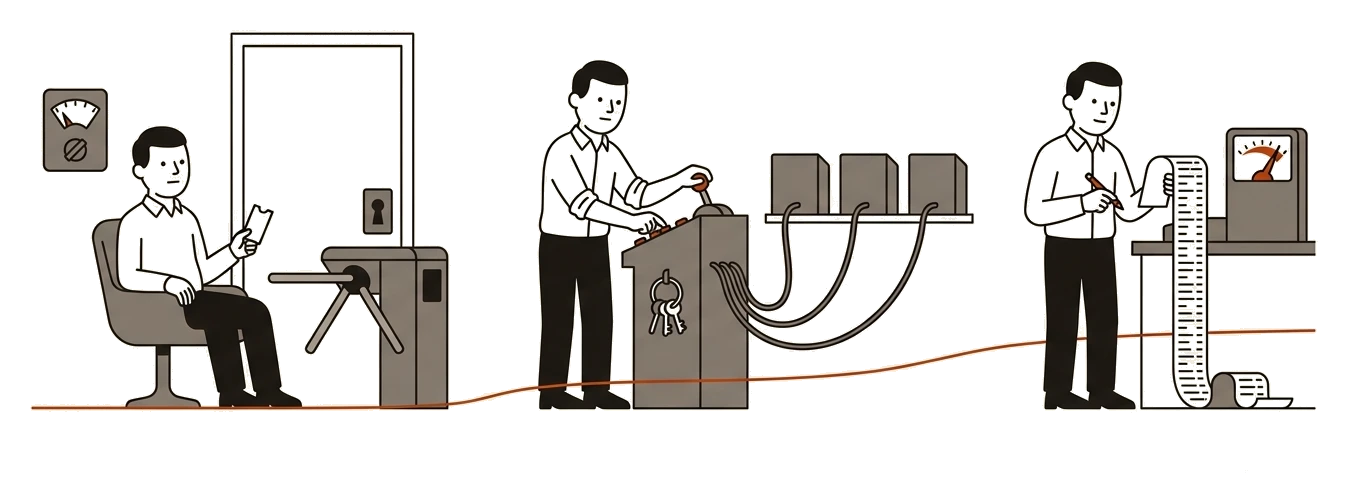
Six months ago I wrote a post called Cheap Enough to Own. It ended with a question about rewriting a small piece of my workflow. I spent five months looking for an alternative. Then I moved my daily work off Claude Code and discovered the least interesting part was the bill.
First surprise: the bill was roughly what I paid before, a little less. The second was better: for the first time, I could read the meter.
The meter you cannot read
A subscription is a meter you cannot read. The number exists somewhere, not for you. You see what share of the session limit remains, not where it went — which model, which task. A limit every five hours carves the day into waiting. Then the calendar is someone else's. Economists named the trap in 2006: flat-rate bias. We pay for the feeling of safety, then avoid the meter because metering feels like a tax.
I installed my own meter. In one thirty-day window, my Claude calendar lit sixteen days. In the next, opencode lit twenty-two. Active days, not cause. The subscription gave me three-quarters of a useful week; I spent the rest waiting. Counting every tool, Cursor included, the blank days mostly disappeared: twenty-four, then twenty-seven. The work had moved, not stopped.
The subscription is not the enemy
I did not cancel everything. I left Claude Code; I kept Cursor. A subscription is a good deal when it buys access you could not assemble yourself — and lets you see the month. The problem is the session limit, not the monthly model. If AI is one of your tools, would you let your electricity or water stop because you hit a limit? Would you wait five hours to drink water?
I know because I took the long way. I built my harness from zero, and learned what reinventing the wheel costs: cheap to run, expensive to keep. I tried Hermes, then DeepSeek's harness, then opencode, and stayed with opencode. My own harness did not disappear — it still runs simple, single-purpose agents. But code and new builds go to the one somebody else already made.
No harness wins on every axis: Claude Code integrates deepest, Cursor spans vendors, opencode gives any provider and full control. Pick your axis. The prescription is a mix, not a cancellation: subscription base, metered overflow, one readable bill. I am still testing it.
Three models, one receipt
The expensive model should plan, not read. My pipeline: the expensive model plans and reviews; cheap workers do the bulk; a tester checks; I read the verdict. Before a decision that matters, I run best-of-n: three fresh candidates think in isolation, a judge grades them, the winner runs once.
But the slogan hides a condition. More turns beat a bigger brain on easy and medium problems (Snell et al., 2024). On hard problems, the bigger model still wins. Test-time compute is not a universal coupon. Competitors keep shipping new models — Fable, Opus, Argon, Luna. Do you need a super-intelligent, expensive brain for every task? I don't. I need a diligent companion, smart enough to finish the work.
Every big file used to enter the expensive model's context; the limit made context scarce. Now a cheap worker reads the file and returns quotes. An oracle byte-checks every quote; unchecked text is quarantined. In one bench, 17,760 bytes went in and 327 came back — 1.8%. The parent sees only the verified quote. Quotes, not files.
That is the receipt I can re-run. Most numbers are borrowed. That one is mine.
Cheap is not better
A new fast cheap model appeared — JEV. Faster. Cheaper. Decisions not clearly better. But it fit some tasks. I also ran a small local model: about fifty tokens a second alone, four inside the harness. The gap was not the model. It was the loop around it.
The METR trial: sixteen experienced developers, two hundred-odd tasks, randomized. They forecast 24% faster with AI; measured, 19% slower. After all those tasks with the same tools, they still guessed 20% faster. Practice does not fix the feeling. One careful trial, not a law. But I recognized the gap: what feels faster and what the invoice says differ.
So I stopped pricing tokens. Tokens are an input; the finished task is the unit. My meter could price a task; the subscription gave me a monthly feeling. Price the task, not the token.
The bill moves to you
The open route is not risk-free. It moves the bill from the vendor to you.
No session limit means no spending cap; a stuck loop can burn a week of budget in an hour. Your code leaves the building; free endpoints may log or train, paid ones can log too. The label is not the box: endpoints can quantize, swap, or shrink context under the same name.
My brakes are boring: a hard credit limit on the key, no-training providers, public questions only on free endpoints, pinned versions, audited quotes. The flat fee hid the meter; the meter shows the risks.
The automation trap
In 1983, Lisanne Bainbridge studied factory automation: automate the routine, and the human loses the skill for the rescue. Forty-three years later, the same trap ships inside the AI harness. The tool that does all the tasks removes the reason you can still do them.
I do not want to use AI less. I want to keep the chair where the decision-maker sits. Delegate the execution. Never delegate the decision.
What you can copy
Try it: read your own bill, see which task and model cost you the most, limit every key you own, route with an aggregator's mindset, and keep the decision.
April: a user, renting access. Summer: an operator, running keys and routes and brakes. October: a buyer, reading the meter. Spotify's engineers found the same thing from the other direction: most of what an agent does is I/O, not thinking. METR filmed those same sixteen and measured exactly that: with AI allowed, real coding time fell from 36% to 24%, and the missing share moved to reading output, prompting and waiting. If the work is I/O, the thinking is the part that stays mine.
In April, the point was cheap enough to own. The update: cheap enough to keep learning. The harness is free; the tokens are not. The win is not the lower bill. It is a readable bill and the freedom to decide when I work. That is worth more than cheap. The tuition remains in the budget.
What did your last invoice teach you?